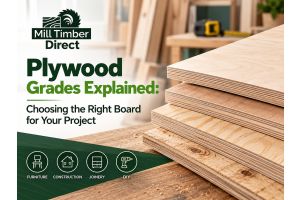
Plywood Grades Explained: Choosing the Right Board for Your Project
The letters used to grade plywood can be confusing. Some boards carry an A, B or C grade, whereas others are marked B/BB, BB/CP or something similar. A higher grade doesn't necessarily mean you're buying stronger plywood. The differences are mainly about the surface finish, although the type of board and its intended use are also important. We've put together this guide at Mill Timber Direct to explain what the various grades mean and where you might use them.
What Do Plywood Grades Tell You?
Plywood is made up of several thin layers of timber veneer, bonded together with the grain running in alternating directions. This is what gives plywood its stability. The appearance grade relates to the outer veneers. Knots, splits, repairs and other natural defects are all taken into account, with the permitted number and size varying between grades.
A board that has a rough looking face can still be perfect for some jobs, whilst a beautiful piece of plywood isn't necessarily suitable for flooring or structural work. You need to consider more than the surface appearance.
“A” Grade Plywood
A grade is generally reserved for plywood with a clean, smooth face and very few visible defects. Large knots and obvious repairs aren't what you'd expect to find here. It's a good choice for furniture where the plywood will be seen, like a fitted bookcase with exposed shelves and side panels that need a neat finish.
You'll have less filling and sanding to do before you paint it as well, although you'll still need to prepare the surface properly. As you might expect, Grade A plywood is the most expensive, so for the back of a wardrobe or a cupboard that's going to be lined, you could look at using a less pricey grade.
“B” Grade Plywood
B grade allows some imperfections, including smaller knots and repaired areas. The exact allowances depend on the grading system, so two boards labelled B grade won't look identical. For furniture that you plan on painting, this can be a reasonable compromise. A few small repairs might not matter once you've applied primer and paint, particularly on a utility cupboard or workshop storage unit.
“C” and “D” Grade Plywood
Some lower grade boards look quite rough. Larger knots, patches and splits may be visible, and the surface can need considerably more preparation if you're planning to paint it. That doesn't mean the plywood has no useful purpose. For concealed work, you might not be bothered about the appearance of the face.
There is a distinction between cosmetic defects and problems that affect the board's performance, however. You can't assume that any lower grade sheet will be suitable for construction simply because nobody will see it.
Understanding B/BB and BB/CP Grades
Plywood often has a different grade on each face. The first letter or group of letters describes one side and the second refers to the reverse. B/BB plywood, for example, has a better quality B face and a BB reverse that contains more imperfections. With BB/CP plywood, the CP face generally permits more defects. This arrangement is quite useful for cabinet making. You can put the better face towards the room and use the less attractive side inside the unit.
Before you cut a sheet, we recommend you check both faces and mark which one you want visible. It's easy to forget when you're measuring out several panels.
Hardwood, Softwood and Marine Plywood
Appearance grades aren't the only difference between plywood sheets. The timber used, construction, and bonding specifications also affect where you can use them.
Hardwood Plywood
Hardwood plywood is often chosen for furniture and shelving. The surface can be particularly attractive, depending on the species and veneer grade. If you're going to leave the timber exposed beneath a clear finish, inspect the grain and any repairs. Two sheets of the same grade can still have quite different appearances.
Softwood Plywood
Softwood plywood is frequently used for roofing, construction and general building projects. A decorative finish isn't usually the priority for these jobs. What matters with softwood plywood is that the board meets your requirements for strength and exposure. Don't rely on the timber type alone when you select structural materials.
What About Plywood Thickness?
Give the thickness as much attention as the grade. A thin board may be fine for the back of a cupboard, but it won't be suitable for a shelf to store heavy books on. For structural work, check the board's classification. EN 636-1 relates to dry conditions, EN 636-2 to humid conditions and EN 636-3 to exterior conditions.
Choosing Your Plywood at Mill Timber Direct
We'd suggest deciding what the board needs to do before worrying about how attractive it looks. A clean face is worth paying for on visible furniture, but it may be unnecessary for concealed construction. You can explore our range of plywood sheets at Mill Timber Direct, with options for DIY, joinery and building projects.
FAQs
Is A grade plywood stronger than B grade?
Not necessarily. The letters describe the appearance of the veneers rather than the structural strength of the plywood. Strength depends on the board's construction and specification.
Can I use plywood outdoors?
Yes, you can, provided that the board is suitable for exterior conditions. Look for the appropriate classification and protect the timber against moisture, paying particular attention to exposed edges.

Short Code:
Credit Limit:
Current Balance: